45.4% of respondents prefer to receive information in the state language, while social media remains the primary source of news
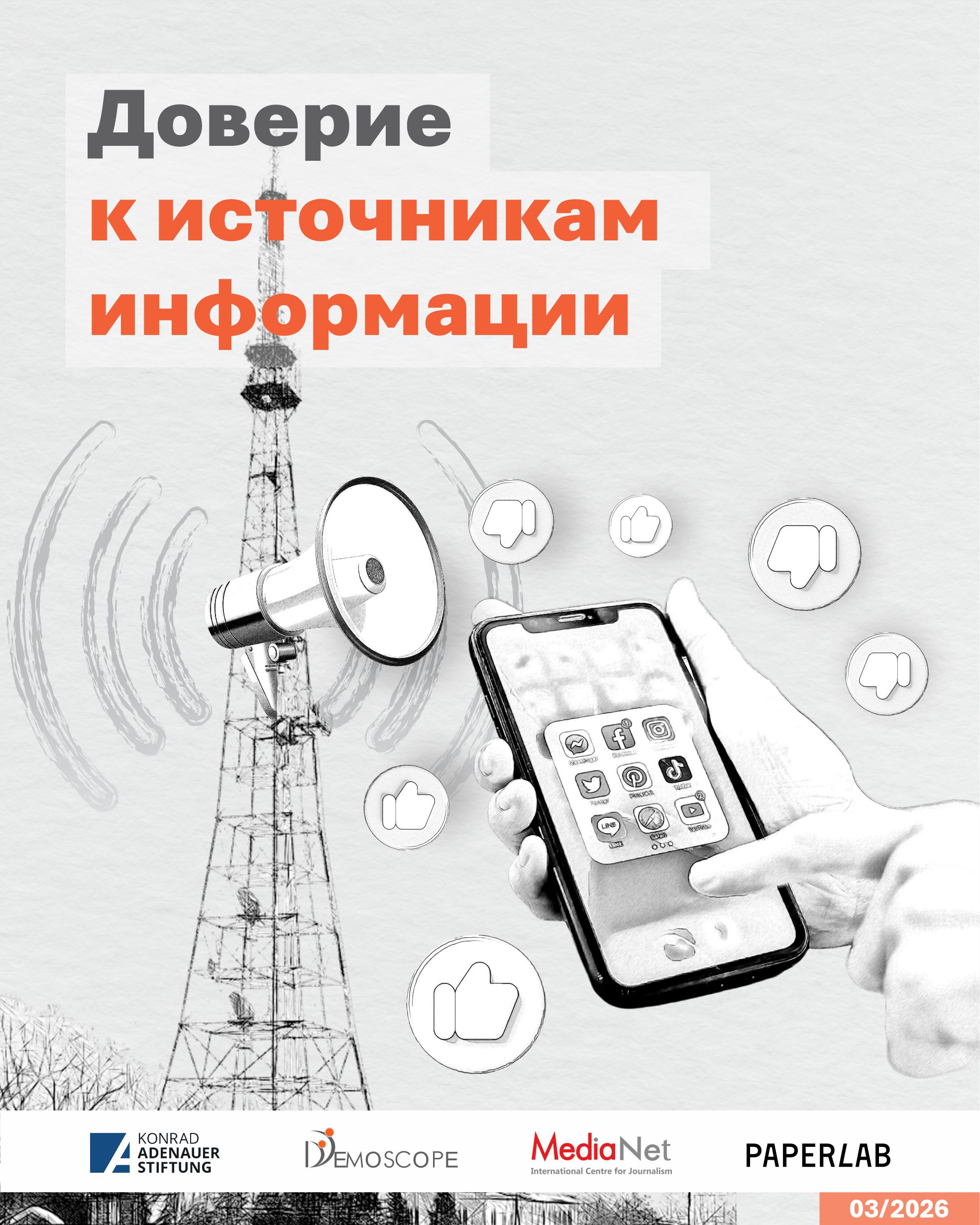
From February 24 to March 6, 2026, the DEMOSCOPE Express Public Opinion Monitoring Bureau conducted a survey of citizens on the topic “Public Trust in Information Sources.” The project is implemented by MediaNet International Center for Journalism in cooperation with the PAPERLAB Research Center and with the support of Konrad Adenauer Foundation.
The DEMOSCOPE survey shows that media consumption patterns in Kazakhstan remain heterogeneous and largely depend on respondents’ language preferences and age.
A key trend is the growing role of the Kazakh language in the media landscape. The survey found that a significant share of citizens – 76.5% in total – consume information in Kazakh. Of these, 45.4% prefer to receive information primarily in the state language, while 31.1% consume information equally in Kazakh and Russian. In addition, one in five respondents (21.1%) consumes information in Russian.
The level of trust in information sources is a significant indicator of media preferences. The survey results indicate pronounced skepticism among audiences toward most media resources. More than half of respondents consider only two sources relatively reliable: state media (57.4%) and relatives, friends, and acquaintances (54.4%). At the same time, 30.9% and 29.7% respectively do not trust these sources.
It should be noted that trust levels vary significantly depending on respondents’ age. The highest level of support for official media (66.4%) is observed among respondents aged 18–29. At the same time, the lowest level of trust is recorded among those aged 50–59 (46.5%).
Kazakhstanis tend to distrust other sources of information:
- Bloggers and opinion leaders: 66.1% do not trust them, 16.6% trust them
- Social media pages and groups: 62.9% do not trust them, 16.7% trust them
- Russian media: 60.7% do not trust it, 18.1% trust it
- Media from other countries: 48.9% do not trust it, 21.9% trust it
- Private media: 43.3% do not trust it, 37.3% trust it
At the same time, millennials (aged 30–39) demonstrate the highest level of skepticism toward influencers, with 72.6% indicating they tend not to trust bloggers. Paradoxically, more favorable attitudes toward bloggers were expressed both by Gen Z (18–29) and respondents aged 50–59, with trust levels of 20.5% and 21.3%, respectively.
Public opinion regarding private media is notably divided. The shares of respondents expressing trust and distrust are nearly comparable: 43.3% do not trust, while 37.3% do. The core audience of private media consists of young people (18–29), where the highest level of support is observed at 49.6%. In contrast, respondents aged 60 and older show the opposite trend, with 52.7% tending not to trust private media.
Media consumption is directly linked to the level of freedom of speech in the country. In 2025, Kazakhstan ranked 141st in the Reporters Without Borders (RSF) World Press Freedom Index, where the situation in the country is assessed as “very serious.”
According to the DEMOSCOPE survey, public perceptions of freedom of speech remain mixed. A total of 34.9% assess it positively, while another third (33.6%) give a neutral assessment. At the same time, 27.2% of citizens evaluate the state of freedom of speech in Kazakhstan negatively. Perceptions vary by age: respondents aged 50–59 are the most critical (36.3%), while younger respondents aged 18–29 demonstrate lower levels of dissatisfaction (23%). These findings correlate with levels of trust in official media, where younger respondents are the most loyal, while the 50–59 age group shows the lowest trust.
The DEMOSCOPE study also identified the most popular sources of information. As expected, social media remains the primary source of news for Kazakhstanis (55.9%). This is followed by online resources (30.6%) and television (30.2%).
Next are YouTube channels (16.1%) and messaging apps such as WhatsApp and Telegram (13.1%). Traditional media – print newspapers (3.4%) and radio (2.5%) – are the least востребованные sources of news. (Respondents could select up to two options for this question.)
Participants were also asked which social media platforms and messaging apps they use most frequently to spend time and obtain information.
The top 5 most popular platforms among Kazakhstanis are:
- Instagram — 58.0%
- TikTok — 39.1%
- WhatsApp — 29.0%
- YouTube — 28.1%
- Telegram — 16.4%
A small proportion of respondents prefer Russian social networks—VKontakte (1.7%) and Odnoklassniki (3.3%). Meanwhile, 14.7% reported that they do not use social media at all. (Respondents could select up to five options for this question.)
An important indicator of the quality of information consumption is the level of media literacy and the ability to verify information. The study showed that a total of 65% of respondents check information before sharing it. Of these, 46.9% do so almost always, while 18.1% do so occasionally. However, 10.8% never verify information in advance, and 7.8% do so very rarely.
Overall, 39.2% of respondents stated that it is not difficult for them to distinguish between reliable and unreliable information – 17.6% said it is very easy, and 21.6% said it is rather easy. Slightly fewer respondents (33.4%) experience difficulties with verification – 13.1% find it very difficult, and 20.3% find it rather difficult. Another 23% do not consider this issue at all.
The DEMOSCOPE study shows that media consumption in Kazakhstan remains diverse and is largely characterized by the growing role of the Kazakh language, pronounced age differentiation, and the importance of media literacy for the adequate perception of information. Social media, online resources, and television remain the main sources of news, while traditional media – print newspapers and radio – are the least used.
Overall, audience trust is largely limited to close social circles – relatives, friends, and acquaintances. Other sources of information, including bloggers, social media pages, and foreign media, generally do not inspire trust.
Given the increasing role of the state language, the production of diverse and high-quality content in Kazakh, particularly targeting younger audiences, is a strategically important issue for domestic media and content creators. Media managers should also adapt content to social media formats and algorithms to ensure maximum accessibility and engagement.
Detailed survey results are available on the project website. The press release and infographics in Kazakh and Russian are available via the link. When using these materials, a hyperlink to the DEMOSCOPE website is required.
Methodology: From February 24 to March 6, 2026, 1,100 respondents were surveyed across 17 regions and cities of national significance (Astana, Almaty, Shymkent). The survey was conducted via telephone interviews among mobile subscribers in Kazakhstan. The sample was based on a database of randomly generated phone numbers. The telephone survey was carried out by the KT CloudLab Contact Center. The sample included 47.4% men and 52.6% women aged 18 and older. A total of 65.8% chose to respond in Kazakh, and 34.2% in Russian. Ethnic composition: 76% Kazakh, 12.2% Russian, and 11.3% other ethnic groups. A total of 68.4% of respondents live in urban areas, and 31.4% in rural areas. Data were weighted by gender and age. The maximum margin of error does not exceed 3% with a 95% confidence level. The response rate was 10.5%. The survey was implemented by MediaNet International Center for Journalism Public Foundation with the support of Konrad Adenauer Foundation. The survey data reflect respondents’ opinions. For additional information, please contact Snezhana Tsoy, the project coordinator: snezhana.tsoy@medianet.ngo.